Your Practical Guide to Web Accessibility, Compliance, and Better UX in 2025
If you’re a business owner, CTO, or digital strategist, there’s a critical question you should be asking in 2025: Is your website ADA compliant?
The Americans with Disabilities Act (ADA) was originally created to ensure public spaces are accessible to all. Today, your digital presence—including your website—is equally vital. A site that lacks accessibility not only risks legal action but excludes a large number of users who rely on assistive technologies.
At Muniwar Technologies, we specialize in inclusive web solutions aligned with ADA and WCAG 2.2 standards. This guide will help you understand ADA compliance, how to assess your current website, and how to improve accessibility quickly and effectively.
Why ADA Compliance Matters More Than Ever
Legal Risks Are Growing
Over 4,500 ADA-related web accessibility lawsuits were filed in the U.S. in 2023 alone, and the number is increasing globally. Even small businesses are being held accountable.
It’s About Serving All Users
1 in 5 people globally live with a disability—including visual, auditory, mobility, or cognitive impairments. An inaccessible website denies access to a significant portion of your audience.
It Improves SEO and UX
Accessible websites are typically faster, cleaner, and better structured, leading to improved search engine visibility and a superior user experience.
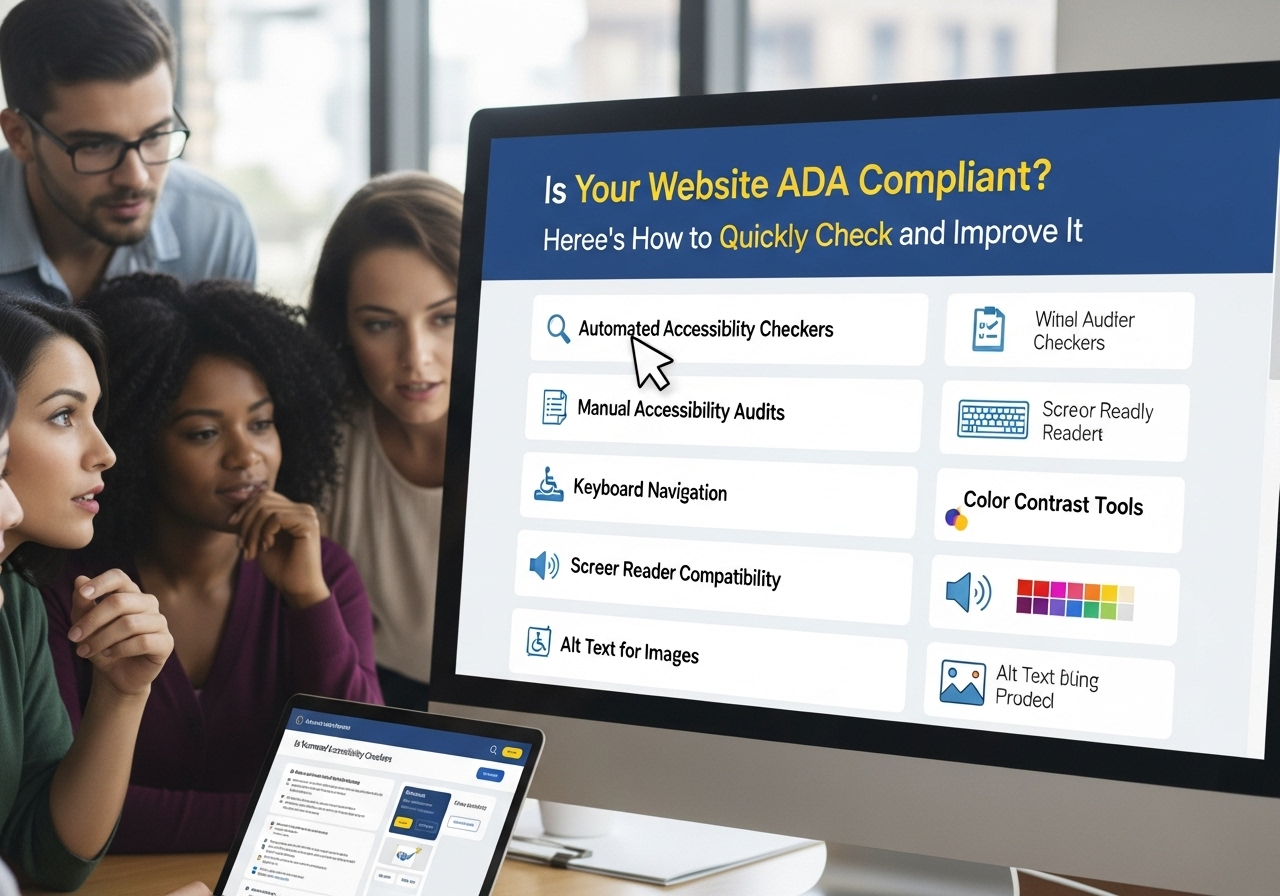
How to Check If Your Website Is ADA Compliant
You don’t need to be a developer to run a basic accessibility check. Here are five quick tests you can perform:
| Checklist Item | What to Look For | How to Test |
| Alt Text for Images | All images should have meaningful alt text | Right-click > Inspect Element |
| Keyboard Navigation | Users should navigate using only the keyboard | Press Tab and Shift+Tab to move through items |
| Color Contrast | Text must stand out clearly against backgrounds | Use WebAIM Contrast Checker |
| Accessible Forms | Inputs need labels; error messages must be visible | Try form filling with a screen reader |
| Skip Navigation Link | A “Skip to Content” link should appear on load | Look at top of the page on keyboard load |
Free Tools to Scan Your Website
- WAVE by WebAIM – Visual tool to identify accessibility issues
- axe DevTools (Chrome Extension) – Runs audits inside your browser
- Google Lighthouse – Generates accessibility scores through DevTools
- Screen Readers – Try NVDA (Windows) or VoiceOver (Mac) for real experience
Common Accessibility Pitfalls (and How We Fix Them)
| Issue | What It Means | How Muniwar Fixes It |
| Missing Alt Text | Screen readers can’t describe the image | CMS is configured to require/edit alt attributes |
| Unlabeled Buttons | “Click Here” gives no context | Replaced with descriptive labels like “Submit Form” |
| Poor Color Contrast | Text is unreadable over the background | We adhere to WCAG 2.2 color contrast ratios |
| Inaccessible Menus | Can’t be navigated via keyboard | We build fully accessible navigation structures |
| No Error Suggestions | Users don’t know why a form failed | Real-time, accessible error messages are added |
WordPress vs Headless CMS: Accessibility Comparison
| Feature | WordPress | Headless CMS (e.g., Strapi + React) |
| Accessibility Plugins | Available (e.g., WP Accessibility) | Requires custom implementation |
| Theme Control | Limited to available options | Fully customizable front-end |
| Developer Flexibility | Constrained by plugins/themes | High—ideal for advanced accessibility |
| Best For | Small to mid-sized businesses | Enterprises needing custom, scalable solutions |
Muniwar Insight: WordPress is efficient with the right setup and vetted themes. For businesses with complex needs, a headless CMS offers full control, performance, and compliance from day one. Real-Life Case Study: Accessibility That Works Client: Fast-growing healthcare startup Challenge: Users couldn’t book appointments using screen readers or keyboard navigation Muniwar Solution:
- Rebuilt the site using a headless CMS and Next.js
- Introduced accessible UI elements and improved contrast
- Integrated form accessibility and real-time error handling
Results:
- Bounce rate dropped by 40%
- Patient signups rose by 22% in 60 days
ADA Compliance Checklist for Your Website Use this quick reference to evaluate your digital platform
- Are all images/videos tagged with alt text or captions?
- Can all features be accessed using only the keyboard?
- Do forms include proper labels and accessible error messages?
- Is the visual design (contrast, fonts, layout) readable across devices?
- Does your CMS support accessibility editing?
- Have you tested the site with assistive technologies (e.g., screen readers)?
How Muniwar Technologies Helps You Stay ADA Compliant
We don’t just fix accessibility—we build it into your digital DNA. Our accessibility-driven process includes:
- Inclusive UI/UX design from the wireframe stage
- Semantic HTML & responsive design for all devices
- CMS configuration that supports accessible content creation
- Automated and manual audits (Lighthouse, axe, NVDA, etc.)
- Staff training on managing accessible content long-term
Conclusion
ADA compliance is not just a box to tick—it’s an opportunity to lead with inclusion. With Muniwar Technologies, your business can deliver an experience that’s inclusive, legally sound, and performance-ready.
Contact Us
Email: info@muniwar.com
Phone: +91 888-22-66-111 | +91-11-43050611
Reach out to Muniwar Technologies today. Let’s build a better, more inclusive web.