How inclusive digital design drives profit, performance, and brand trust
Most people assume accessibility in web design is only for users with disabilities. While supporting inclusion is the foundation, the reality is that accessible websites consistently outperform non-accessible ones in SEO, conversions, user satisfaction, and legal protection.
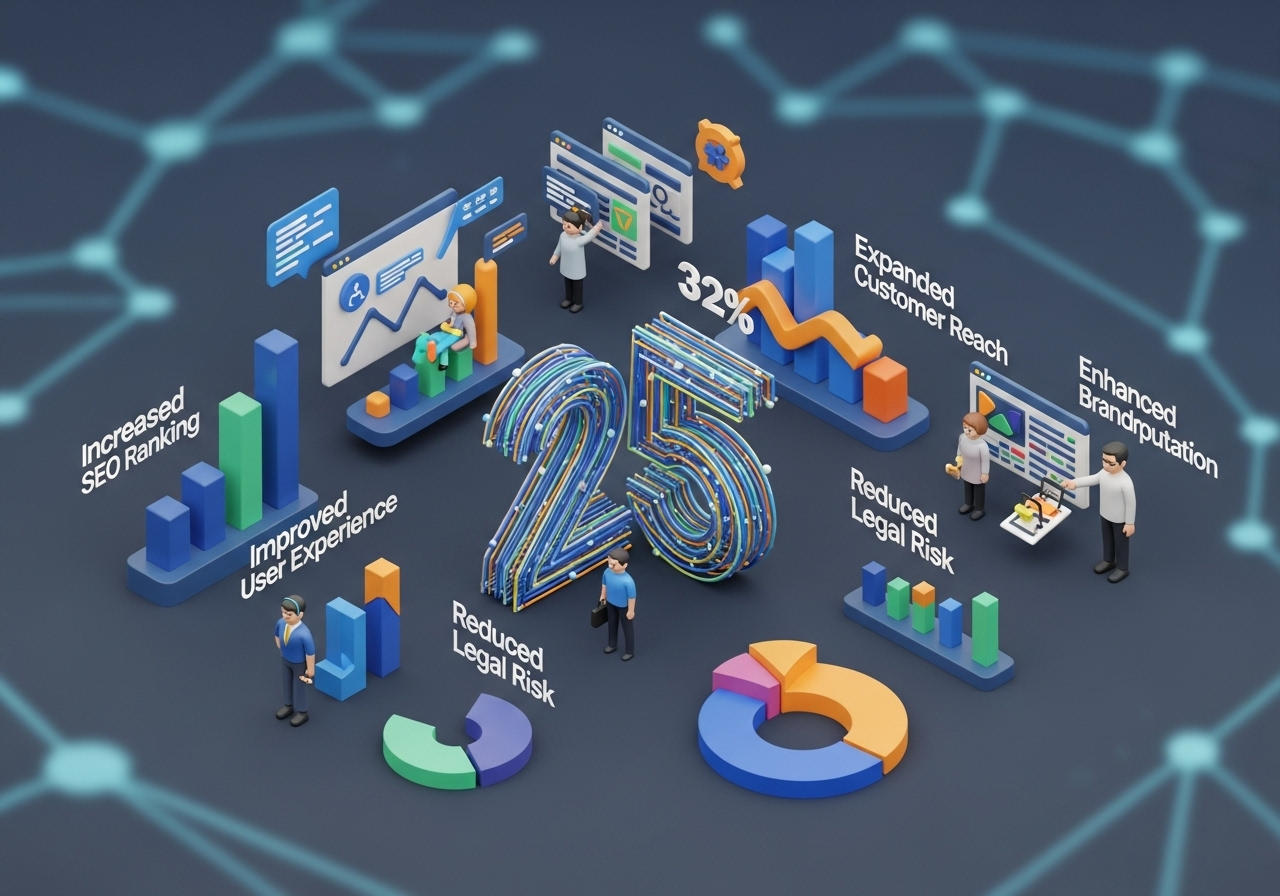
In short, it’s not just the right thing to do—it’s also smart business. Whether you’re a CTO, startup founder, or digital decision-maker, these 25 stats reveal why accessibility must be part of your core digital strategy.
Why Accessibility Should Be a Business Strategy
Accessible websites benefit everyone. Faster load times, cleaner layouts, and intuitive navigation improve usability for all. With increasing regulations and customer expectations, accessibility has become essential for brand credibility and risk management.
Here’s the data to prove it.
25 Eye-Opening Accessibility Stats Every Business Should Know
1–5: The Market You’re Missing
- 1.3 billion people globally live with a disability – WHO
- 71% of users with disabilities will leave a site immediately if it’s not accessible – WebAIM
- Inaccessible websites lose $6.9 billion annually in potential revenue – Forrester
- Over 61 million adults in the U.S. alone live with a disability – CDC
- People with disabilities have $1.2 trillion in annual disposable income – Return on Disability
You’re potentially turning away a large market segment with substantial purchasing power.
6–10: Accessibility Affects SEO
- Google ranks accessible websites higher, especially those using semantic HTML and alt text
- Page speed, a ranking factor, improves with clean, accessible coding
- Voice search compatibility increases with accessible design
- Descriptive link text boosts click-through rates
- Structured data and ARIA roles support both bots and screen readers
Example: A Headless CMS like Next.js ensures faster, more accessible websites, which Muniwar delivers with expertise.
11–15: Conversion and UX Gains
- Accessible websites see a 12% increase in traffic and 15% boost in conversions – Click-Away Pound
- 69% of users with accessibility needs abandon e-commerce sites that are hard to use
- Accessible forms reduce cart abandonment by 35%
- Good color contrast and readable fonts improve user retention by 50%
- Clear navigation raises customer satisfaction by 30%
A smoother experience benefits all users, including those on mobile or with temporary impairments.
16–20: Legal and Compliance Impact
- Over 4,600 ADA lawsuits were filed in 2023 for web inaccessibility in the U.S.
- Non-compliant websites risk fines up to $150,000 per violation
- WCAG 2.2 compliance is a requirement in many government contracts
- India’s Rights of Persons with Disabilities Act mandates digital accessibility
- 79% of companies updated their websites recently to avoid legal risk
Muniwar helps you stay legally compliant through expert audits and implementation support.
21–25: Brand and Reputation Wins
- 88% of users report greater brand loyalty to accessible websites
- 90% of Gen Z expects brands to be inclusive and socially responsible
- Accessibility is now a key CSR metric for global corporations
- Accessible content is shared more often due to clarity and ease of use
- Companies prioritizing accessibility report 20% higher customer satisfaction
An inclusive design strategy directly enhances brand trust and customer loyalty.
WordPress vs Headless CMS: Which Is Better for Accessibility?
| Feature | WordPress | Headless CMS (e.g., Strapi + Next.js) |
| Accessibility Plugins | Available (e.g., WP Accessibility) | Manual coding required |
| Flexibility | Moderate | High (custom frontend control) |
| Developer Dependency | Low to Medium | Medium to High |
| Performance | Moderate (depends on theme) | High (scalable, fast, SEO-optimized) |
| Compliance Control | Plugin-based | Full control over WCAG compliance |
Muniwar Insight: WordPress offers a faster, more budget-friendly route to accessibility. For performance-driven businesses, a Headless CMS provides full control and long-term scalability.
Quick Accessibility Checklist
Before launching your next website or digital product, ensure it includes:
- Keyboard-friendly navigation
- Sufficient color contrast
- Alternative text for all images
- Semantic HTML and ARIA roles
- Descriptive and meaningful links
- Form labels and error messages
- Resizable fonts and mobile responsiveness
- Testing with screen readers and assistive tech
Muniwar conducts manual audits, uses leading accessibility tools, and performs real-user testing to meet WCAG 2.2 standards.
Conclusion
Accessibility in web design is no longer a nice-to-have—it’s a competitive edge. These 25 statistics clearly demonstrate that inclusive design leads to higher revenue, better SEO, lower legal risk, and increased brand loyalty.
Whether you’re launching a new CMS, redesigning your website, or developing an e-commerce platform, accessibility must be baked into your digital foundation from day one.
Muniwar Technologies is your trusted partner in building accessible, high-performing digital solutions that empower all users and future-proof your brand.
Let’s Talk Accessibility-First Design
Ready to turn accessibility into a strategic advantage? Partner with Muniwar Technologies to design and build compliant, fast, and user-friendly platforms that reach every audience Phone: +91 888-22-66-111, +91-11-43050611